What is the level of Lake Bolsena?
The level of many Italian lakes has recently received significant interest (e. g., see here), and also the level of Lake Bolsena (see our recent news and various articles in...

The level of many Italian lakes has recently received significant interest (e. g., see here), and also the level of Lake Bolsena (see our recent news and various articles in...
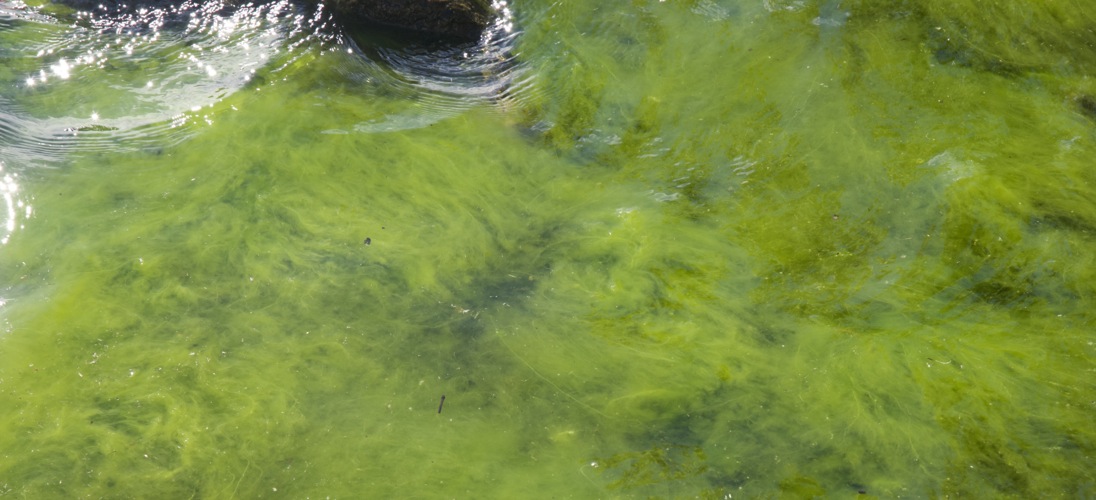
Eutrophication is a process that causes the degradation of an aquatic ecosystem. It is caused by an over-abundance of nutrients in the water.
The high availability of nutrients leads to an increase in the production of biomass in the form of algae and, consequently, of biomass of the animals that eat them. With the increase of living biomass, the dead biomass also grows, formed by the remains of plants and animals that fall to the lake bottom. These remains are initially decomposed by micro-organisms that live in oxygenated environments; since the process of decomposition consumes oxygen, deep waters become deprived of oxygen until it disappears completely. Under these conditions, other species of micro-organisms continue the decomposition, which becomes a process of putrefaction and fermentation, releasing toxic substances.
The natural state of Lake Bolsena is called ‘oligotrophic’; that is, with low nutrient content. It is the state of the “lake to drink” of one hundred years ago, characterized by clear, well-oxygenated and healthy waters. In these waters phytoplankton and zooplankton grow in small quantities, but of great biodiversity. The lake is populated by many valuable species of fish.
In recent years the eutrophication process has begun in Lake Bolsena. Currently the ecological state of the lake is ‘mesotrophic’, i.e. in an intermediate condition; it is rapidly moving towards eutrophy, if adequate measures are not taken to halt the process.
In the second half of the last century pollution of the lake by nutrients coming from sewage and agriculture began. In the 1990s a waste water collection system was created, administered by COBALB (….). This, even if not complete, managed to stem the pollution for a while. Since about 2008 , however, the collector has been functioning less efficiently, and there have been numerous and important sewage spills until the completion of the reparation work; in addition, nutrient input from farms is increasing.
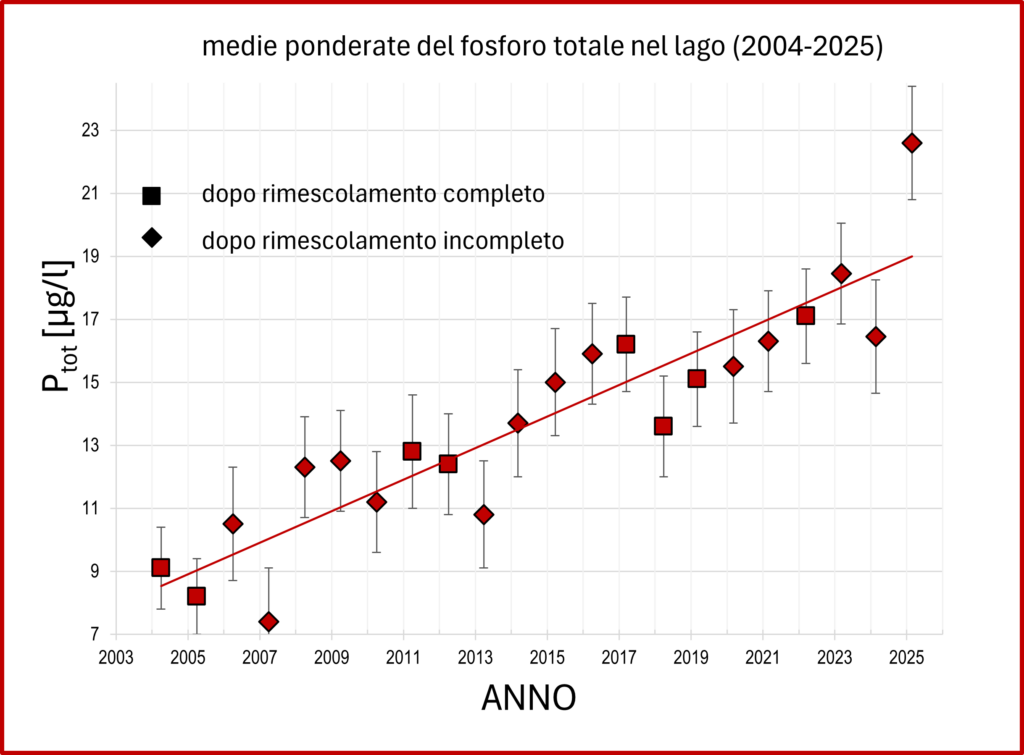
As in many lakes, the nutrient responsible for degradation is phosphorus, found in sewage and also in fertilizers used in agriculture. Its concentration is continuously increasing and has triplicated in the last twenty years (see graph). This fact is serious: Lake Bolsena is extremely vulnerable because it will take many years, about 300, to renew its waters. All pollutants, including phosphorus, remain in the lake and accumulate there.
Another major cause of degradation is the weakening of the lake’s natural self-healing processes, e.g. through the almost total destruction of its natural riparian vegetation.
Adopt and promote eco-sustainable behaviour:
Counteract abuses by detecting and reporting to the authorities the spillage of waste water, all pollution of any origins and the destruction of natural vegetation along the shores of the lake.