



For over 20 years, the association “Lake Bolsena ” has been regularly monitoring the key physical and chemical parameters of the water to determine the lake’s trophic level and its evolution.
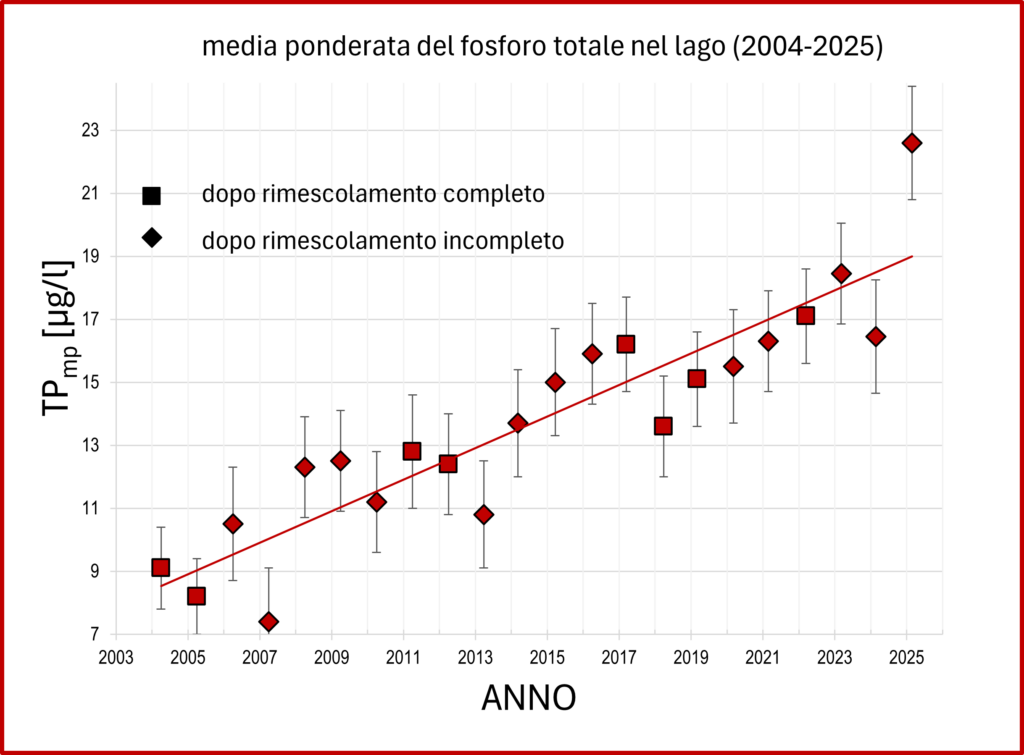
Evolution of the weighted mean of total phosphorus concentration in the lake, from 2004 to 2025.
A recent press release, whose title we have used for this news item and which, alluding to Battiato’s “Cura”, illustrates the commitment of the lake’s residents, highlights a problematic ecological situation, with a significant increase in total phosphorus, from values close to 8 μg/l in the 1970s to nearly 23 μg/l in 2025.
At the same time, a decline in oxygen content in the deep layers has been observed, halving during this period, as well as increasingly widespread and prolonged anoxia at the lake bottom.
This dynamic accelerates the process of eutrophication and signals an overall ecological deterioration.
A detailed presentation and discussion of these data can be found in the full report “The Trophic Level of Lake Bolsena Updated to Spring 2025” which can be downloaded from the association’s website here.
We have informed the relevant authorities at all levels of government, including the European Commission, of this situation.
The almost complete disappearance of common reed belt, which once served as natural filters and phytodepuration, and the reduced effectiveness of natural deep-water mixing processes due to climate change, contribute to worsening the situation.
In 2004, the lake’s trophic state was still “excellent” and equal to its natural state. Today, in 2025, the trophic state is only “sufficient.”
To address these critical issues, the association proposes a set of integrated measures, including interventions on sewerage systems, sustainable agricultural practices, and ecological restoration actions. This is also the context for the proposal to organize a Conference uniting all of the lake’s stakeholders in 2026, aimed at involving institutions, research bodies, and citizens in a shared path of protection and remediation.

