


 The Castel Giorgio geothermal power plant proposed by ITW & LKW Italia is a “pilot” track system with a power of 5 MWel. With its decision of 31 July 2019, the Council of Ministers allowed “the continuation of the process of construction of the plant” (see History (it)).
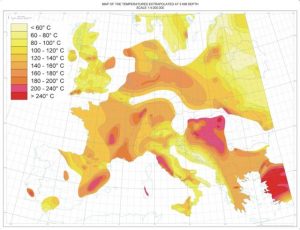
In Europe the areas where the use of geothermal resources is economically attractive are found in Iceland, France, Germany, Hungary, Turkey and Italy (fig. 1).
Here in Italy, the areas of interest (fig. 2) are represented first of all by the area of Larderello, where geothermal energy has been exploited for more than 100 years, then by the hills around the Cecina Valley, by Amiata, by the area of Vesuvius and, finally, by the area of Lake Bolsena.
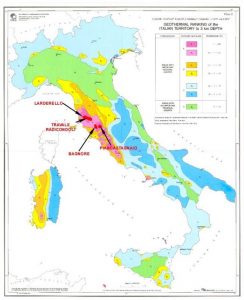
fig. 2
Indeed, the entire area around the lake is invested with permits for research and for the exploitation of geothermal energy requested by various companies. The colours in the image (fig. 3) distinguish these areas according to the state of administrative progress of the project: the most advanced is in Castel Giorgio, ready to be realised.
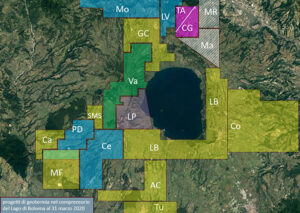
fig. 3
The area affected by the Castel Giorgio plant is very close to the inhabited area (fig. 4). It consists of the power plant where electricity is generated, and in two poles: the extraction pole (orange circle and symbols) of the geothermal fluid (hot water of about 130°C, which contains dissolved gases and various substances from the subsoil, for the most part harmful), and the pole where the cooled fluid is reintroduced into the subsoil (blue circle and symbols). The whole area affected by the project is at the edge of the lake’s hydrogeological basin (the re-injection wells are inside it), and therefore it affects all of the lake’s aquifer.
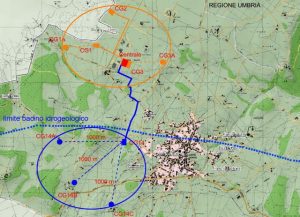
fig. 4
In the vertical section (fig. 5), we see that the lake, laterally, is about 6 km from the plant; vertically, however, the shallow aquifer, which is at one with the lake, is only a few hundred metres from the geothermal reservoir. The geothermal reservoir is a layer of permeable rock that contains the geothermal fluid in its pores, fractures and voids. It is separated from the aquifer by a slightly permeable older layer (“liguridi”) and a more permeable and more recent one (“neogenic-quaternary deposits”). However, be careful: all these layers are crossed by faults, that is rock breakage planes, which are connecting channels between the various layers. The faults are witnesses to the history of Lake Bolsena, a consequence of the collapse of the complex volcanic system that created the caldera of the lake, and are concentric to the lake. The closer we get to the lake, the denser the distribution of faults and the more upset the subsoil. Geologically, this area is characterised by very recent volcanic activity (the last eruptions were only 100,000 years ago) and great fragility.
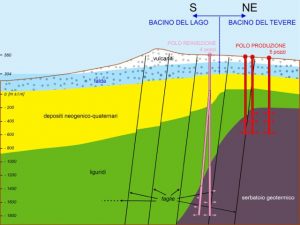
fig. 5
The conditions for operation of the plant and the safety of the environment and the population are: 1) a perfect separation between the geothermal reservoir and the shallow aquifer; 2) free circulation in the geothermal reservoir of geothermal liquid. This is precisely the model of the subsoil that the proposing company puts at the base of its project. However, it is only a hypothesis. There are no scientific arguments to support this hypothesis.
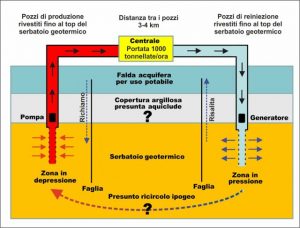
fig. 6
From the diagram (fig. 6) we understand why it is so important that the two conditions are met: geothermal fluid is extracted, its heat is released, and it is returned to the tank; it must be able to return to the extraction point and warm up as it goes. If this is not the case, a strong depression is created at the extraction point, and a strong overpressure at the injection point, with three negative consequences: 1) near the extraction point, the underpressure sucks in water from the aquifer through the faults; 2) at the injection point, the overpressure pushes the geothermal fluid into the aquifer and contaminates it; 3) the pressure imbalances favour violent rock movements, inducing earthquakes.
Unfortunately, science – specifically the recent publication by Vignaroli and co which summarises all the studies carried out on the geology of the area – shows that the reality of the subsoil does not correspond to the ideal hypothesis of the proponent, but that faults facilitate exchanges and vertical flows, and that the fluid in the tank does not circulate freely, but that the tank is divided into compartments that hinder the flow.
With this it is clear that (from a scientific point of view) the plant presents risks of induced earthquakes, pollution of the groundwater table and depletion of the groundwater. The lake is SIC (site of community interest) and protected by specific laws, which impose the application of the principle of precaution, stating: “when there is uncertainty as to the lack of detrimental effects for the integrity of the site … the competent authority shall refuse authorisation “.
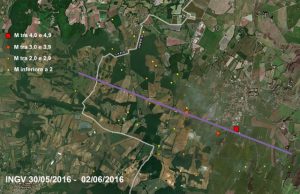
fig. 7
The geological fragility of the subsoil is demonstrated by the fact that at Castel Giorgio earthquakes of important magnitude occur. The image (fig. 7) shows the epicentres of earthquakes in the seismic swarm that occurred in 2016. The weighted median line crosses the area where re-injection wells are planned and follows the line of an active fault highlighted by Buonasorte et al (1988).*
A serious risk of a different order is represented by the expected multiplication – in the event that the Castel Giorgio plant is built – of geothermal power plants around the lake, with the transformation of our territory into a widespread industrial area.
We cannot allow this: the vocation of the lake district is quite different. The lake is an important, precious site, as there are few in Italy and in Europe, protected by European and national legislation as a reserve of biodiversity and drinking water resource. We cannot run the risk of destroying it.
Moreover, it would not be worth it: the plants produce little energy and have a poor yield, only about 5% (ie 5% of the heat is converted into electricity). In our area, characterised by recent volcanic activity and geological fragility, there are safe and sustainable alternatives to this risky technology. Here are some of them:
- use of geothermal heat with DHE probes (heat exchangers inserted in deep wells)
- photovoltaic panels: 10 ha of surface are enough to produce as much electricity as the Castel Giorgio plant, about a thousand roofs covered with panels
- small wind plants
- savings and increased energy efficiency
*Buonasorte, G., Cataldi, R., Ceccarelli, A., Costantini, A., D’Offizi, S., Lazzarotto, A., et al. (1988). Ricerca ed esplorazione nell’area geotermica di Torre Alfina (Lazio-Umbria). Boll Soc Geol It, 107(2), 265–337.

