


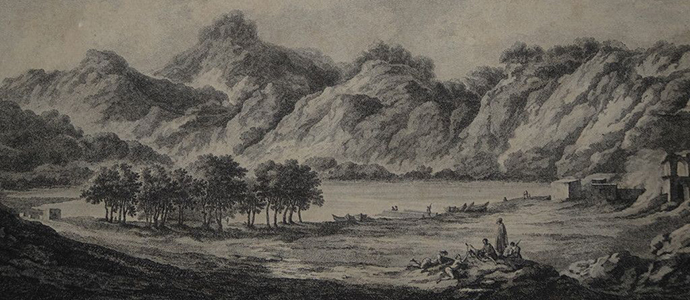
An incredible thing has happened in Agnano, a town located in the caldera of the same name in the Municipality of Pozzuoli, in the red area of the Campi Flegrei, a dormant supervolcano and one of the most dangerous in the world.
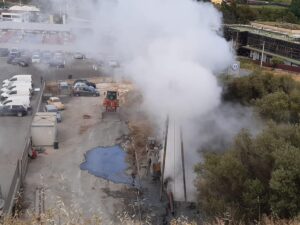
On June 8, the GRADED company started drilling a well for a geothermal project (see here for a complete summary (it)). Quickly spills of steam, gas and dust were produced, causing a fumarole up to a height of 50m. Alerted by the worried population, the Mayor ordered the closure of the construction site two days later.
 Drilling is part of the GeoGrid project, with the aim of “developing innovative technologies and systems for the sustainable use of high, medium and low enthalpy geothermal resources with plants of high energy efficiency and reduced environmental impact”. The project, in which the CNR (National Research Council) and the INGV (National Institute of Geophysics and Volcanology) along with various universities in the area participate as ‘beneficiaries’, is financed by the Campania Region with a contribution of 3.6 million euros.
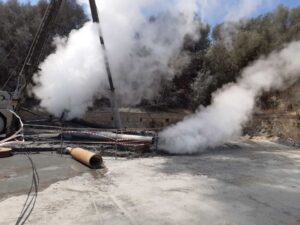 However, the Municipality was not aware of the drilling works, which were carried out with unsuitable equipment and without the minimum safety measures. In 2015 the Municipality of Pozzuoli expressed its opposition to geothermal projects. In addition, in 2017 the ‘Scarfoglio’ geothermal project was rejected by the Region, in this same area of Agnano. Furthermore, INGV itself (beneficiary of the GeoGrid project!) had also expressed opposition to the ‘Scarfoglio’ project.
***
Why are we talking about this incident in the distant Campi Flegrei? Because once again it shows us that for geothermal companies, protection of the environment and human lives is a negotiable option. It shows us that universities and research institutes can lend themselves, for little money, to guarantee dangerous scientific projects. But it also shows us that a courageous mayor can stop a dangerous project.
We also talking about it because the incident has given us access to a hitherto secret internal report of the INGV. It is part of the INGV report with the subject “Geothermal drilling in the Campi Flegrei area – Geogrid project”, and it can be found on page 40 onwards with the title “evaluation of volcanic and seismic hazards inducible from the exploitation of geothermal energy in sites at Bagnoli, Scarfoglio (Campi Flegrei) and Serrara Fontana (Isola d’Ischia)”. In-depth report by the INGV ‘geothermal drilling’ working group.
The report, which was prepared at the request of the Civil Protection Great Risks Commission by the most respected of national geologists and volcanologists, extensively cites the arguments advanced by Giuseppe Mastrolorenzo, senior INGV researcher, and confirms their validity. We will analyse the content carefully, but already at a first reading it is clear that all scientists agree there are serious shortcomings in the projects mentioned (and the same is true for the projects proposed around Lake Bolsena and in Tuscany!). In particular, it states that:
“… in the opinion of the GdL (Working Group), there is no adequate definition of the seismic-tectonic framework which, given the degree of earthquake hazard in the region capable of producing devastating effects, cannot be neglected” (from the conclusions regarding the Serrara Fontana permit). It continues: “… this geothermal reservoir, into which the fluid, which is different and isolated from that intended for production, is returned, is not known from a hydrogeochemical point of view and has not been the subject of any form of investigation by the proponents of the project. It is therefore not possible to evaluate the variations of the geothermal system induced by the reinjection of cooled fluids into tanks other than the one for pumping.
“It is believed that the assessment of any possible increase in the seismic hazard of the area as a result of the construction and operation of the planned geothermal plant was made without having a reliable seismic-tectonic model available.”
In the light of these authoritative opinions, we ask for a re-evaluation of the environmental impact for the Castel Giorgio and Torre Alfina plants.

