


For many lakes around the world, water levels are managed and regulated to prevent them from becoming too high or too low relative to their natural average. Since ancient times, humans have intervened to prevent fluctuations in the levels of lakes and rivers from causing damage, and to derive the greatest possible benefit from these water bodies.
An excessively high lake water level presents several risks:
- flooding, which can damage homes, roads, and other infrastructure;
- erosion of the shorelines;
- a reduction in the size of bathing beaches.
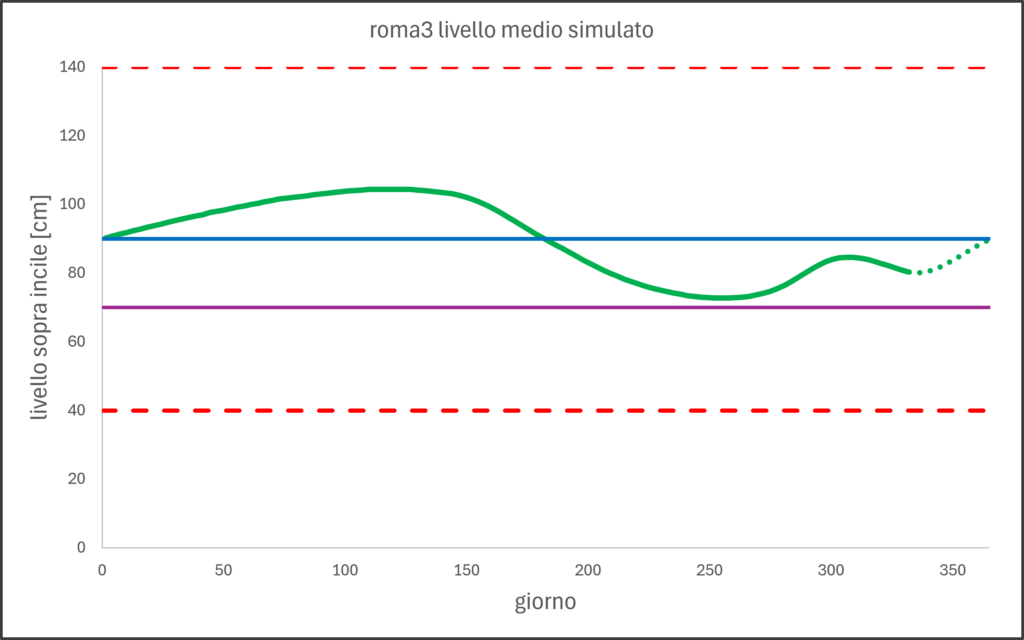
Graph 1: Optimal mean water level according to the study “Gestione dell’Incile del Lago di Bolsena” (Management of the Lake Bolsena Outflow) by the University Roma Tre. Also shown (in red) the upper and lower warning thresholds, the mean water level (in blue), and the minimum water level permissible from an ecological perspective (purple).
On the other hand, if the water level drops too low:
- harbors may become impassable;
- aquatic habitats and shoreline zones suffer damage, and
- an adequate flow into the outlet river is no longer guaranteed throughout the year.
Proper management of the water level is especially important today, as it helps to mitigate the predicted effects of climate change—such as prolonged droughts, extreme precipitation events, increased evaporation from the lake’s surface and the vegetation in the catchment area.
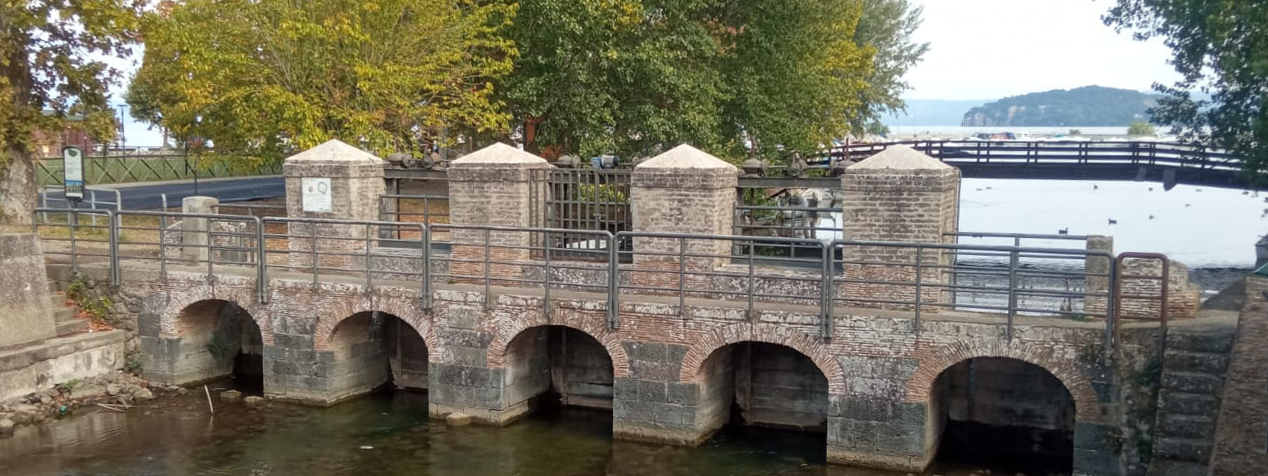
The water level of Lake Bolsena is regulated by adjusting the opening of the five sluice gates (known as “bocchette”) of the “Traversa sul Marta” structure, which controls the outflow into the Marta River. This process follows the indications of a study by the Roma Tre University, which specifies an “optimal mean water level” for each day of the year (see Graph 1). With the resolution by the regional government, dated April 14, 2016, adjusting the actual water level to align with this optimal mean value has become a legal requirement.
This “optimum curve” tracks the natural seasonal fluctuations of the water level while, at the same time, aiming to optimally satisfy the requirements listed above.
Prerequisites for the proper management of the lake level are:
- reliable measurement of the current lake level;
- the ability to quickly adjust the current level to the prescribed optimum level;
- a scientific and up-to-date model for determining the optimum level.
Although measurements are now taken using modern instruments (and with mm-precision), none of these prerequisites are met:
- there are two different sets of level measurements, both provided by public agencies, which differ by approximately 38 cm (see Graph 2 and our previous news). ). Neither corresponds to the actual water level;
- regulation of the water level occurs only a few times a year and does not appear to be guided by any coherent strategy;
- the model used to determine the optimum level dates back 20 years and thus fails to account for important changes since then in the underlying conditions.
Therefore and unsurprisingly, the alignment between the actual level and the prescribed level is unsatisfactory (see Graph 2)—in 2020, 2021, and 2026, the actual levels were higher than those prescribed, while in other years, the actual levels were significantly lower.
It is therefore necessary to:
- clearly determine the actual water level of the lake,
- improve the regulation of the sluice gates,
- refine and update the model for the optimal average water level.
For an in-depth discussion of the issue, see the article by the Osservatorio Ambientale del Lago di Bolsena.
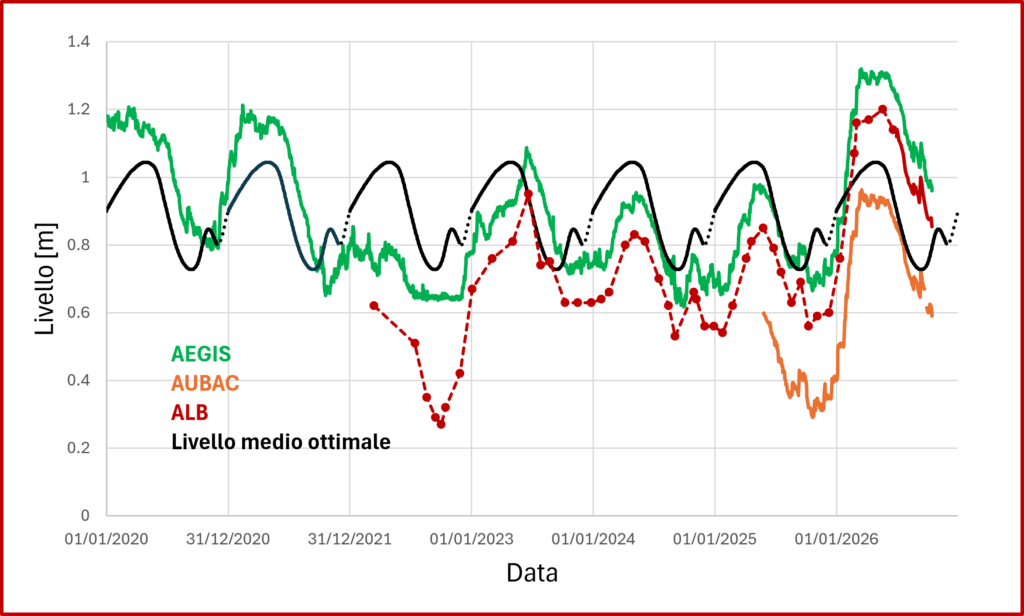
Graph 2: Comparison of the recorded values against the standard, from 2020 to October 2026. The black line represents the optimal average level as per the regulation; the green line shows the curve recorded by the AEGIS instrument (data available from 2020); the orange curve represents the data recorded by AUBAC (data available from the end of May 2025); and the red line shows the monthly data recorded by ALB, representing the actual level (recording was interrupted between 2015 and 2022).

