

In a recent article, the Osservatorio Ambientale del Lago di Bolsena analysed the impact of this year’s drought on the lake. We’ll summarise the main points.
According to the predictions of the IPCC (Intergovernmental Panel on Climate Change), the water shortage caused by climate change will increase in the future. It is therefore necessary to take immediate measures to protect the lake and to improve its management, something which has been until now given little attention.
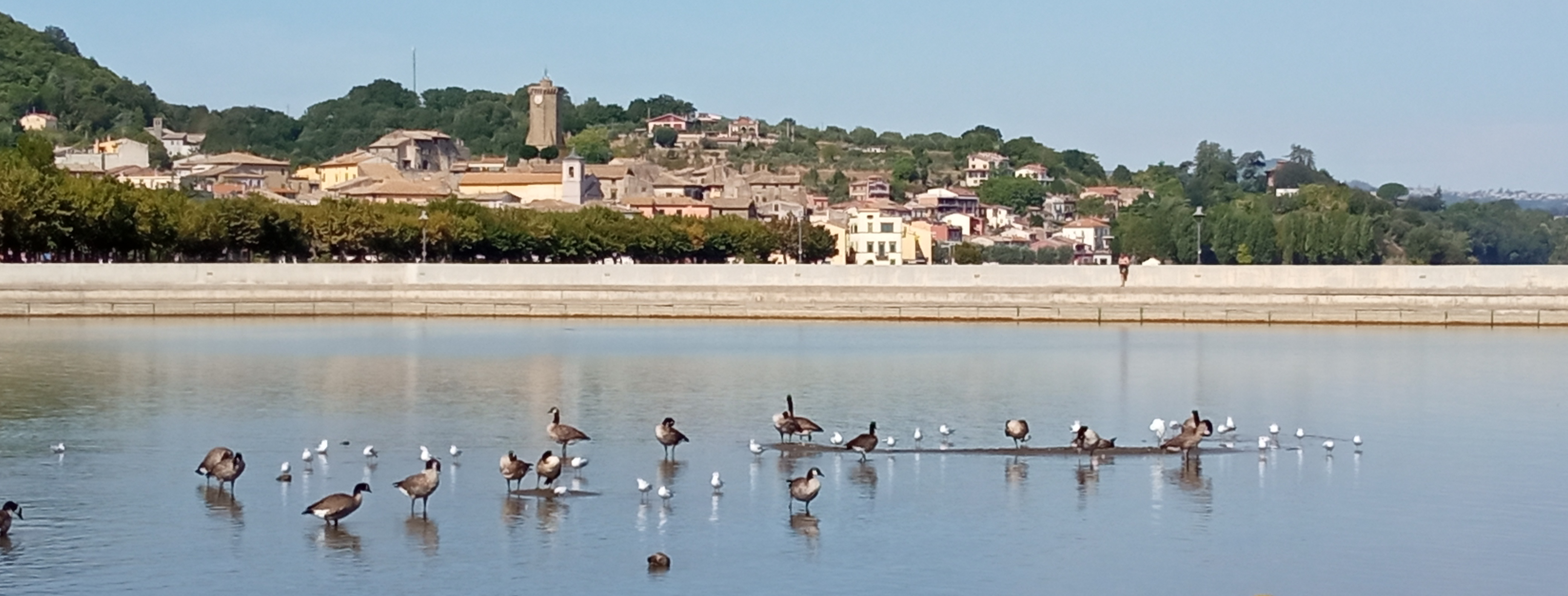
It’s not just the lack of rain that has caused the lake level to drop 50cm below the optimal long-term average (permitting geese to walk inside the port of Marta as seen in the photo above). Two other factors have contributed: the progressive depletion of the water reserve stored in the lake’s volcanic aquifer over recent years and too-generous opening of the gates on the Marta River.
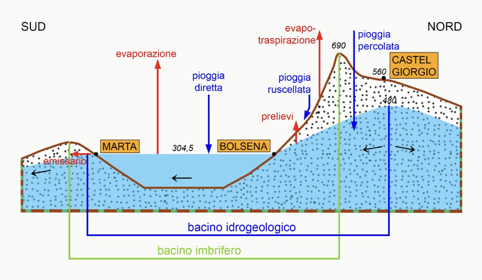
Schematic representation of the aquifer of Lake Bolsena. The ‘mirror’ of the lake is the visible part of a larger aquifer, divided into two parts: the free volume of the lake and the groundwater housed in permeable volcanic material (indicated with dots). Its level is determined by the water balance, calculated from water inputs and outputs.
The measures to be taken can be deduced from the illustration, and are of two types: those that decrease the water losses from the lake (red arrows) and those that modify the inflow (blue arrows).
In order to minimise water loss from the lake, it is clear that we need to reduce losses through evapotranspiration (evaporation from the soil and water released by vegetation) and to control the runoff from the Marta river. It is more difficult to increase water input since this comes exclusively from rain, but it seems to be possible with appropriate measures in vegetation and landscape. An important measure is to support the filling of the volcanic aquifer, which in this way can guarantee a continuous and slow supply of water even during periods of drought.
For it to be able to offer us its services – drinking water, healthy bathing water for our leisure and water to irrigate crops – it is essential that the lake with its water resource is protected, that pollution is avoided and that its ecosystems are healthy and resilient. We do not want to repeat the mistakes that have seriously reduced the water resource of Lake Bracciano (see here) and that have polluted the waters of Lake Vico (see here).
The Osservatorio proposes the following measures:

