


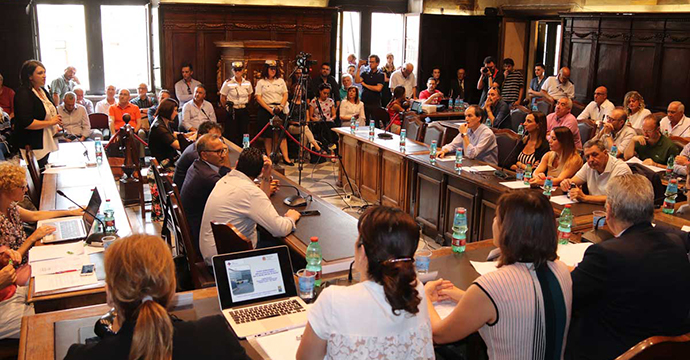
On Thursday 11 July at 3.30pm an extraordinary city council, open to the public, was held at the Palazzo dei Priori in Viterbo (click here for the article on lamiacittanews.it) on the risk for public health due to chemicals, in particular arsenic, radon and pesticides.
The council lasted almost 5 hours and saw the participation of numerous experts on the subject: Dr. Angelita Brustolin (ASL Viterbo) who presented data from the cancer registry of the province of Viterbo, Dr. Daniela D’Ippoliti (Epidemiology Department of the Lazio Regional Health Service) who presented a study on the effects of arsenic on the population of some municipalities of Tuscia, Pietro Paris (ISPRA, the Higher Institute for Environmental Protection and Research) who spoke about the effect of pesticides and fertilisers on the environment and health (click here for the article on tusciaweb.eu), Dr. Milena Bruno (ISS, Higher Institute for Health) who illustrated several studies on the state of Lake Vico, Prof. Umberto Mosato (Institute of Public Health, the Catholic University of the Sacred Heart, Rome) who spoke about the correlation between the use of pesticides and fertilisers and the onset of human pathologies and, finally, Prof. Nicola Lacetera (Department of Agricultural and Forest Sciences, University of Tuscia) who closed the debate with a reflection on the balanced use of pesticides and the need to maintain economic development of the agricultural area. Various municipal councilors then commented on what the experts had said.
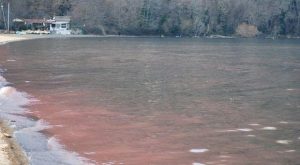
Red alga in Lake Vico, winter 2017 (Il Messaggero)
As a reflection on the future of Lake Bolsena, we briefly report what has been said, in particular by Dr. Milena Bruno of the ISS. She spoke of the plague of Planktothrix Rubescens (commonly known as “red alga”) which has been blooming for years in the cold season in Lake Vico due to an increase in phosphorus in the basin. Dr. Bruno explained that it is a cyanobacterium that produces toxic microcystins which, according to various scientific studies, are responsible for diseases such as Parkinson’s, Alzheimer’s, neurological disorders and tumors, as well as gastrointestinal allergic reactions and skin rashes. The two communities that collect drinking water from Lake Vico (Caprarola and Ronciglione) have had to equip themselves with specific purifiers (for arsenic and microcystins) to cleanse the contaminated water. Dr. Bruno also cited the study that has been carried out by the Sentinel-1 and Sentinel-2 satellites, as part of the European satellite program Cyano Alert, to detect the presence of chlorophyll, heavy metals and toxic cyanobacteria, as well as to detect spills of chemicals and sewage which enter Lake Vico via the drains. These surveys have confirmed high levels of phosphorus, resulting in the lake being halfway between “mesotrophic” and “eutrophic”; in other words “in a comatose state” as repeatedly stated by Prof . Nascetti of the University of Tuscia (click here for the article on etrurianews.it).
Milena Bruno then spoke of the analyses of lake fish fauna, in particular whitefish; toxins up to 38 times higher than the allowed threshold have been detected in the whitefish of Lake Vico.
Analyses were also carried out on the hazelnuts widely cultivated around the lake, examining the fruit of trees that are on the shores of the lake (whose roots take water directly from the aquifer contaminated by cyanobacteria) and those found at 20 km away from the lake, on the heights. It emerged that the hazelnuts produced near the lake are contaminated, while those collected 20 km away are not.
At this point, the following questions arise:
- Can we, at Lake Bolsena with a water replacement time of 3 centuries, afford to find ourselves in the position of having to ask the University of Tuscia to implement the mitigation measures that are being adopted on Lake Vico (which has a replacement time of 17 years) and which still have not, unfortunately, stopped its degradation?
- Do we want to get to the point of having to organise, here on Lake Bolsena, regular conferences and debates on statistics and the correlation between the use of pesticides and tumors and other human diseases?
- Would it not be better to take preventive action? Would it not be better to fight against disinformation and economic speculation that would condemn our territory to total degradation? Shouldn’t we strive to protect professional fishing, tourism and the excellent products of our land?
- Would it not be better for everyone to demand, loudly, the end of regional incentives for intensive hazelnut farming (read here why) in favour of organic crops in the lake basin and the neighboring Alfina plateau?
- And is it not worth taking advantage of this important moment of reflection on the future of agriculture in our area to spread good rural practices, to discourage the use of pesticides in all crops, instead replacing them with sustainable methods that due to their characteristics do not compromise the great heritage of biodiversity?
Misinformation is the greatest enemy of community well-being. We have taken on the task of keeping you informed in order to avoid, in our area at least, the risk that a commercial system geared to maximum profit pushes farmers to make wrong choices, thus jeopardizing the right to a sustainable future for the young generations.

