


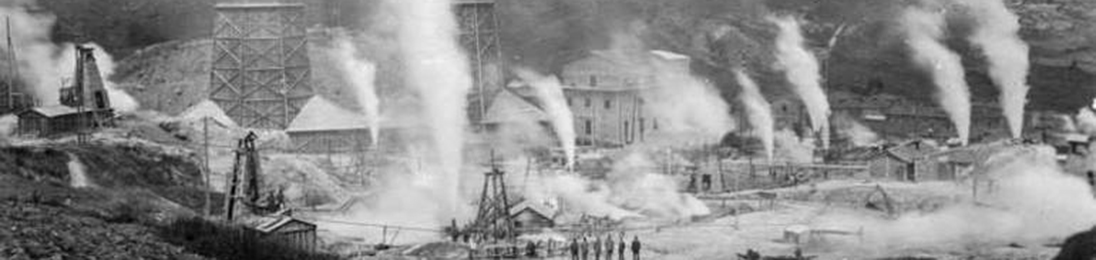
The industrial exploitation of medium and high enthalpy geothermal energy can cause risks for the population and for the environment:
- atmospheric emissions with air, water and soil pollution
- exchange of liquids between the geothermal tank and surface aquifers
- subsidence
- induction and triggering of earthquakes (see also here).
What are the risks of a particular system, and how serious are these risks? It depends on the type of plant and where it is located.
Places
There are many similarities between the geological, geophysical and geochemical characteristics of the subsoil in the Lake Bolsena basin and in the area around Monte Amiata. The geothermal fluid that feeds the plants is similar in composition: hot water in which can be found various gases (a high concentration of CO2, H2S, NH3 CH4, etc) and other harmful substances such as mercury and arsenic. The places where the plants are located also have similar characteristics: great natural and ecological value, surrounded by protected areas and with a low population density. They also have in common their volcanic origin, a complex geological structure and significant earthquake risk.
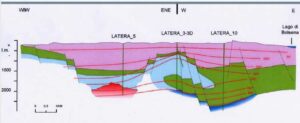 The Latera basin is a composite caldera, created in part by the collapse of its volcano and bearing the imprint of various other volcanic events in the Vulsino district. An idea of its structure, albeit simplified, can be seen from the geological sections in the illustration opposite.
The Torre Alfina geothermal field is located on the northern edge of the caldera of the Vulsino complex. The area ipresents various fissure vents and is crossed by numerous faults and fractures produced by the collapse of multiple magma chambers, with a total subsidence exceeding 1,000 metres. Here, our knowledge of the characteristics of the subsoil is fragmentary, insufficient to predict the effects of drilling or of the withdrawal and injection of large quantities of fluid.
It is important to note that all the models and simulations of the characteristics of the subsoil presented by the proposing companies in environmental impact studies are based on drastic and inadmissible simplifications.
The plants
The “Nuova Latera” power plant is, like the ENEL power plants of the Amiata, of the “Flash” and “open cycle” type. Despite various filters, these plants release a large amount of fluid into the atmosphere, polluting a large surrounding area. A particularly negative effect is that they release large quantities of carbon dioxide, the climate-changing gas par excellence: the “Nuova Latera” would emit even more than a conventional thermal power plant (see here).
On the other hand the two plants designed on the Alfina plateau (Castel Giorgio and Torre Alfina) are binary and “closed cycle” and should therefore not cause emissions into the atmosphere. However, they have other risks in common with the Latera project.
Regarding the exchange of liquids between the geothermal reservoir and surface aquifers, there are possible connections for the Latera and Alfina projects (especially along the fault planes) demonstrated by the presence of numerous faults. The operation of the plants creates an imbalance in the geothermal reservoir divided into more or less “watertight” compartments as demonstrated for the Torre Alfina field by the work of Vignaroli et al.
This fact has two unwanted consequences:
- pollution of the groundwater and thus the drinking water with geothermal fluid. This occurs when the fluid injection creates an overpressure in the geothermal reservoir.
- in the event of negative pressure in the reservoir, for example near the production wells, drinking water is sucked into the geothermal tank.
The real existence of these two effects has been demonstrated in the geothermal fields of Toscana and was also observed during the brief operation of the old power plant in Latera in 1999/2000.
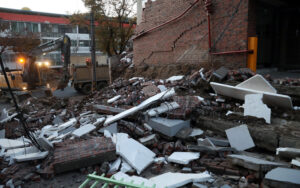
Effects of the triggered geothermal earthquake in Pohang (South Corea, 2017)
Induction and triggering of earthquakes is one of the most harmful consequences of the industrial exploitation of deep geothermal energy, especially in areas such as ours, with on the one hand geological fragility due to multiple tectonic and volcanic upheavals, and on the other a very vulnerable historical building heritage.
All activities associated with the construction and operation of geothermal power plants can induce or trigger earthquakes. The probability is particularly high during the injection of liquids into the subsoil, as is the case for closed cycle plants.
The magnitude of induced and triggered earthquakes can reach that of the natural seismicity of the area. For the Lake Bolsena area, this means a magnitude of just under 6 on the Richter scale, and with devastating effects (up to strength 9 on the Mercalli scale).

