


With the establishment of the organising committee, a decisive step has been taken on the path towards the creation of the Lake Bolsena biodistrict. The next steps in this process, started more than 4 years ago, are the proposal for the identification and establishment of the biodistrict and finally appraisal, recognition and establishment by the Region. The press release follows.
The process for the establishment of a Lake Bolsena biodistrict is underway
Over 30 farms, 10 municipalities and numerous civic associations. This is how the Lake Bolsena biodistrict appears at the starting line. Even before its formal constitution there is extensive consensus among citizens, administrators and producers that promises to make it a true protagonist of local development, a subject capable of guiding the ecological transition process required by the European Union.
The organising committee being set up proposes a rethink from a viewpoint of eco-sustainability and respect for the environment, to create new economic opportunities and to make Lake Bolsena an area of excellence in Italy. The biodistrict takes into account the strong link between public administrations, companies, schools, associations, tour operators and consumers for an integrated management of local resources, enhancing organic production and promoting the enhancement of the natural and cultural wealth of the area.
Acquapendente, Bolsena, Celleno, Cellere, Gradoli, Grotte di Castro, Latera, Montefiascone, Proceno and San Lorenzo Nuovo are the first municipalities to have joined the organising committee. A list destined to grow given that further deliberations are already on the agenda. Biodistricts are recognized by the Food and Agriculture Organisation of the United Nations (FAO) as effective and innovative tools for sustainable territorial governance and are now a reality in Italy where over 30 have been established.
There are many advantages for companies, either organic or in the conversion phase, which decide to join the 32 farms already involved: organic farmers would see a widespread diffusion and enhancement of their products in all commercial businesses, in catering and public canteens (including those of schools) of the lake area. Also the creation of a “Lake Bolsena biodistrict” brand would be seen as a guarantee of quality and a way to promote the territory.
There are also many advantages for citizens who would see the protection of their health, the local production of quality organic food and the beauty of the landscape. The biodistrict, by organising training events, information and farmers’ markets, will represent a centre of social, cultural and artistic exchange, as well as a great opportunity for tour operators to seasonally adjust their offers by focussing on rural tourism.
A fundamental role will also be played by educational institutions, which are ready to include environmental education as part of lesson plans. It is no coincidence that the Lake Bolsena biodistrict logo was designed by a student of the Grotte di Castro secondary school. But above all the lake and the aquifer will benefit from the creation of the biodistrict and be protected by sustainable agriculture thanks to the reduction of harmful fertilisers, pesticides and herbicides used in conventional agriculture.
The startup group of the future biodistrict refers to the contributions of scientific and cultural bodies, including the University of Tuscia, the National Research Council (CNR), the International Society of Doctors for the Environment (ISDE), and a scientific committee which currently includes over twenty agronomists, biologists, geologists, lawyers, doctors, ecologists, engineers, physicists, archaeologists and journalists.
The meetings of the startup group are inclusive, attended by a varied representation of bodies and civic associations with the ultimate aim to nominate the real organising committee and sail towards the establishment of the Lake Bolsena biodistrict.
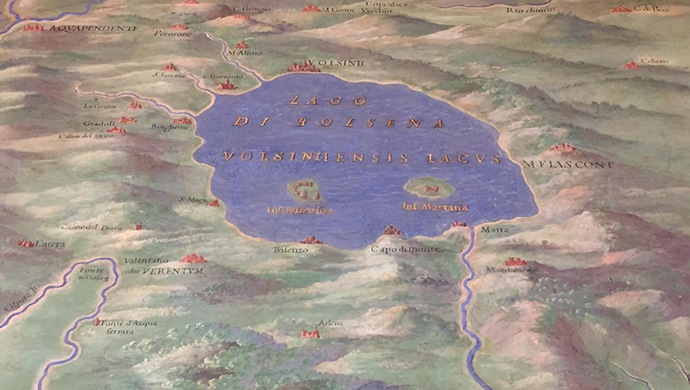
- In the photo above, a detail of the area surrounding Lake Bolsena, Galleria delle Carte Geografiche, Vatican Museums (1580-85).

