

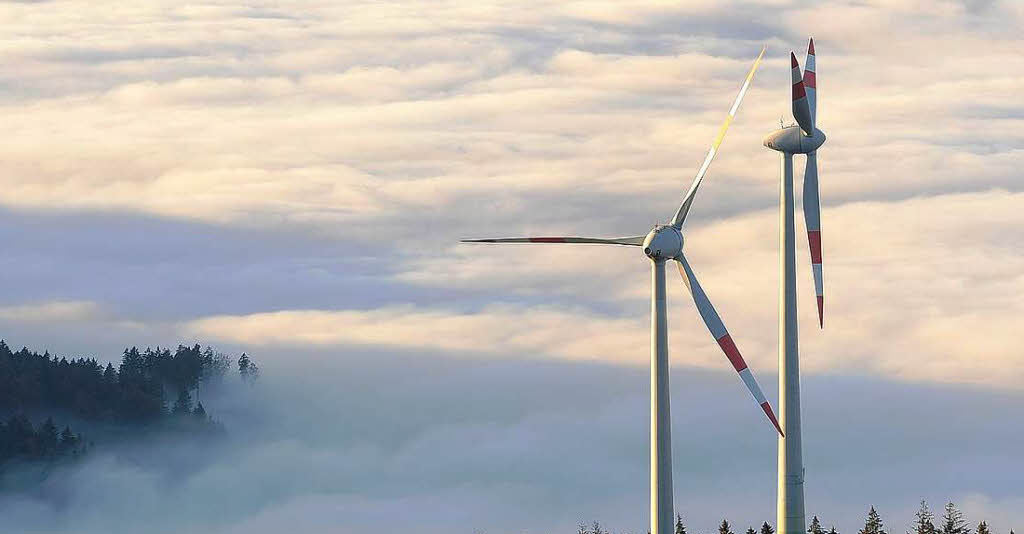
Slowly, secretly, giant wind power is trying to infiltrate the area of Lake Bolsena.
In a first phase with a project of at least four medium-sized wind turbines or “blades” in the Montefiascone area, in a second phase with a project of seven large-sized generators located between Montefiascone-Capobianco and Bagnoregio.
The first project is proposed by EWT Italia, a company of Dutch origin that has become a world operator specialising in medium-power turbines with direct drive technology, where the rotating device of the blade directly drives the generator.
The EWT-DW61 type generators have a hub height of 69m and a rotor diameter of 61m, giving a blade height of about 100 metres. The power of each of the generators is 0.975 megawatts (MW). Their locations are indicated on the map opposite.
The project takes advantage of the fact that according to current legislation, wind power plants consisting of a single isolated wind turbine with a power not exceeding 1MW do not require an environmental impact assessment.
The second plant, located in the area between Montefiascone and Bagnoregio, is still in the planning stage and is proposed by the large multinational SAIPEM. These would be wind turbines with a blade height of more than 200m and a power of more than 5MW.
In both cases, the project provides for the expropriation of land.
Large wind farms on land have a significant impact on the environment and landscape. We have already presented counter-arguments in detail in our observations relating to a wind farm near Tuscania: the plants are located on Italy’s main bird migration route, contribute to the anthropization of an as yet undisturbed landscape and pose a threat to species protected in various Natura2000 sites.
We oppose these wind farms, which represent a further step towards the industrialisation of the Lake Bolsena area along with geothermal projects, solar farms and hazelnut plantations. We are against these projects not because we are against renewable energy, quite the opposite: we are convinced that a switch to sustainability, even in the energy sector, is essential.
We insist, however, that the plants must have the lowest possible impact on the environment and the landscape, and that they follow the path laid out in the Regional Energy Plan, which suggests solar panels on roofs and brownfield sites; small wind turbines; large off-shore wind farms.
Only these solutions are compatible with a future vision for the area based on sustainable agriculture and tourism, where our priceless heritage, cultural wealth and rural landscape, still largely intact, are protected and promoted. This vision also supports our commitment to the creation of the biodistrict of Lake Bolsena.

