


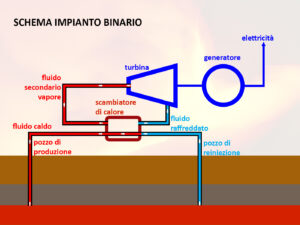
 The pilot plant of Torre Alfina is similar in many respects to the (almost) twin plant of Castel Giorgio. It is a binary system plant with total reinjection of medium enthalpy geothermal fluid, taken from the Alfina geothermal field
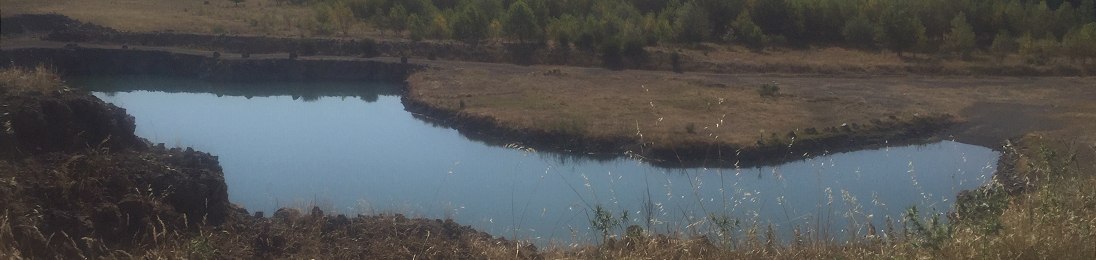
Five production wells take 800 t/h of fluid which is then returned via four reinjection wells. The ORC plant produces 5 MW of electricity (compared with 42 MW of thermal energy which, due to the absence of nearby residential centres, cannot be used) and is located in the area of the former quarry (now a small lake, see photo)”Le Greppe” in the municipality of Acquapendente.
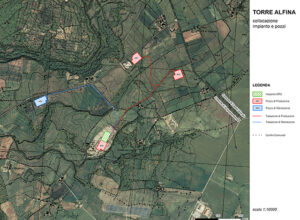 Three of the production wells begin near ENEL’s A1 well, the first drilled in this field, which met a gas bubble (carbon dioxide) at a depth of 600m leading to an eruption. All the wells use the experiences of ENEL exploration and attempt to reach zones affected by fractures and faults, which are therefore of high permeability. All the wells are between approximately 1,200 and 1,500 metres in depth.
While the Castel Giorgio plant provides for the extraction of water by submerged pumps capable of keeping the water under pressure to avoid incrustations forming, the Torre Alfina plant uses a different system, mainly because the fluid is extracted with wells that cross the gas bubble, where the carbon dioxide concentration in the fluid is low (about 1.8%).
The geothermal fluid is extracted from the reservoir at a temperature of about 140°C, without the use of pumps by injection of a gas (nitrogen). In the production pipe, carbon dioxide is separated from the water and a two-phase fluid is extracted. At the same time as the nitrogen, a substance is injected that inhibits calcium carbonate incrustations, which would prevent the proper functioning of the system.
Before entering the ORC plant (Organic Rankine Cycle – the plant uses the Rankine process of operating steam turbines with organic liquids), the non-condensable gases contained in the fluid are separated from the geothermal water. The plant produces electricity by using the heat contained in the incoming water at about 130°C. Upon leaving the plant, the cooled gases are mixed again with the cooled geothermal water (at 70°C), and the fluid is re-injected at a pressure of approx 15 bar. The project envisages a net electrical efficiency of 8.6%, which is too optimistic according to the literature.

